Chan-Ye (Chris) Ohh
Postdoctoral Scholar
Marine Physical Laboratory, Scripps Institution of Oceanography, UC San Diego
Experimental fluid mechanics & data-driven methods for understanding ocean flows
About
I am a postdoctoral scholar in the Marine Physical Laboratory at Scripps Institution of Oceanography, UC San Diego, working in the Air-Sea Interaction Laboratory. My research combines laboratory experiments and data-driven analysis to understand how density stratification shapes fluid flows in the ocean.
I received my PhD from the University of Southern California in 2023, where I worked with Prof. Geoffrey Spedding in the Stratified Fluids Laboratory. My dissertation focused on the wakes generated by bluff bodies moving through stratified environments — a problem with direct connections to underwater vehicle hydrodynamics and oceanic turbulence. Using towed experiments in a large stratified water tank and dynamic mode decomposition (DMD), I developed new approaches for identifying and classifying wake regimes from limited flow measurements.
Add a paragraph about your current research in the Air-Sea Interaction Laboratory with Luc Lenain — e.g., surface wave dynamics, air-sea fluxes, upper ocean turbulence, wave breaking, or remote sensing.
Add a forward-looking paragraph for faculty applications, e.g.: “My research program aims to bridge lab-scale stratified flow experiments with field observations, developing new measurement and data-driven techniques for understanding ocean mixing and transport processes.”
Research
Stratified Ocean Wakes
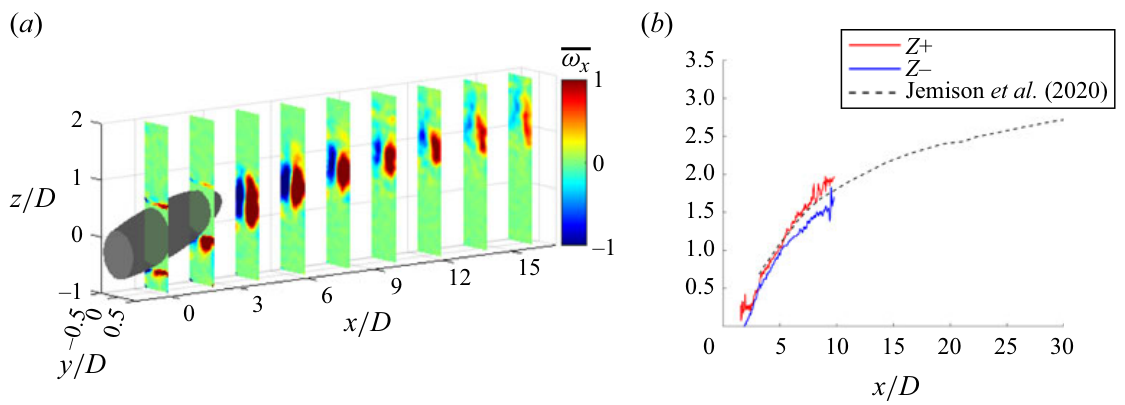
When objects move through density-stratified water — as submarines, autonomous underwater vehicles, and marine organisms do in the ocean — their wakes behave fundamentally differently than in uniform fluid. Buoyancy forces suppress vertical motions, reorganize vortex structures, and create distinctive internal wave signatures that can persist far downstream.
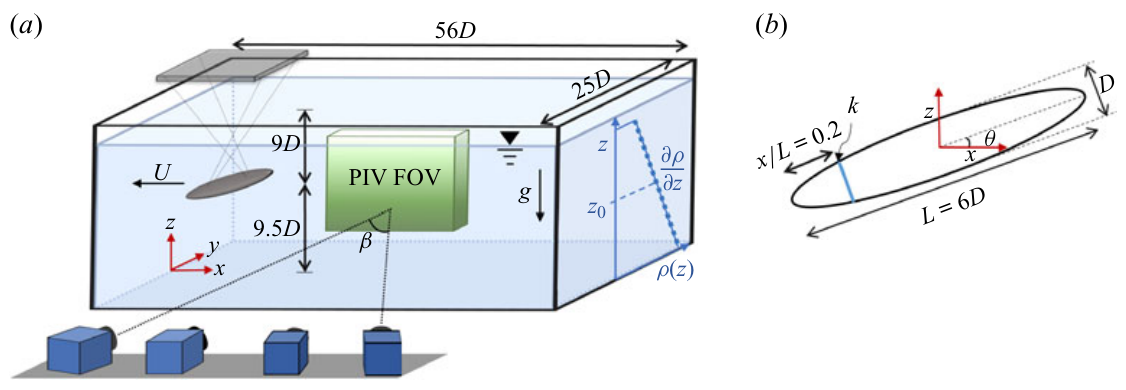
My experimental work uses a large tow tank with precisely controlled density stratification to study these wakes systematically. By towing scaled models through stably stratified water and measuring the resulting flow fields with particle image velocimetry (PIV), I have mapped how wake structure transitions across the Reynolds number and Froude number parameter space.
Related: Ohh & Spedding (2024) JFM, Ohh & Spedding (2022) PRF
Data-Driven Flow Identification
Real ocean measurements are sparse — sensors are expensive, and you rarely have the luxury of full-field data. How do you identify what kind of flow you are observing from just a handful of measurement points?
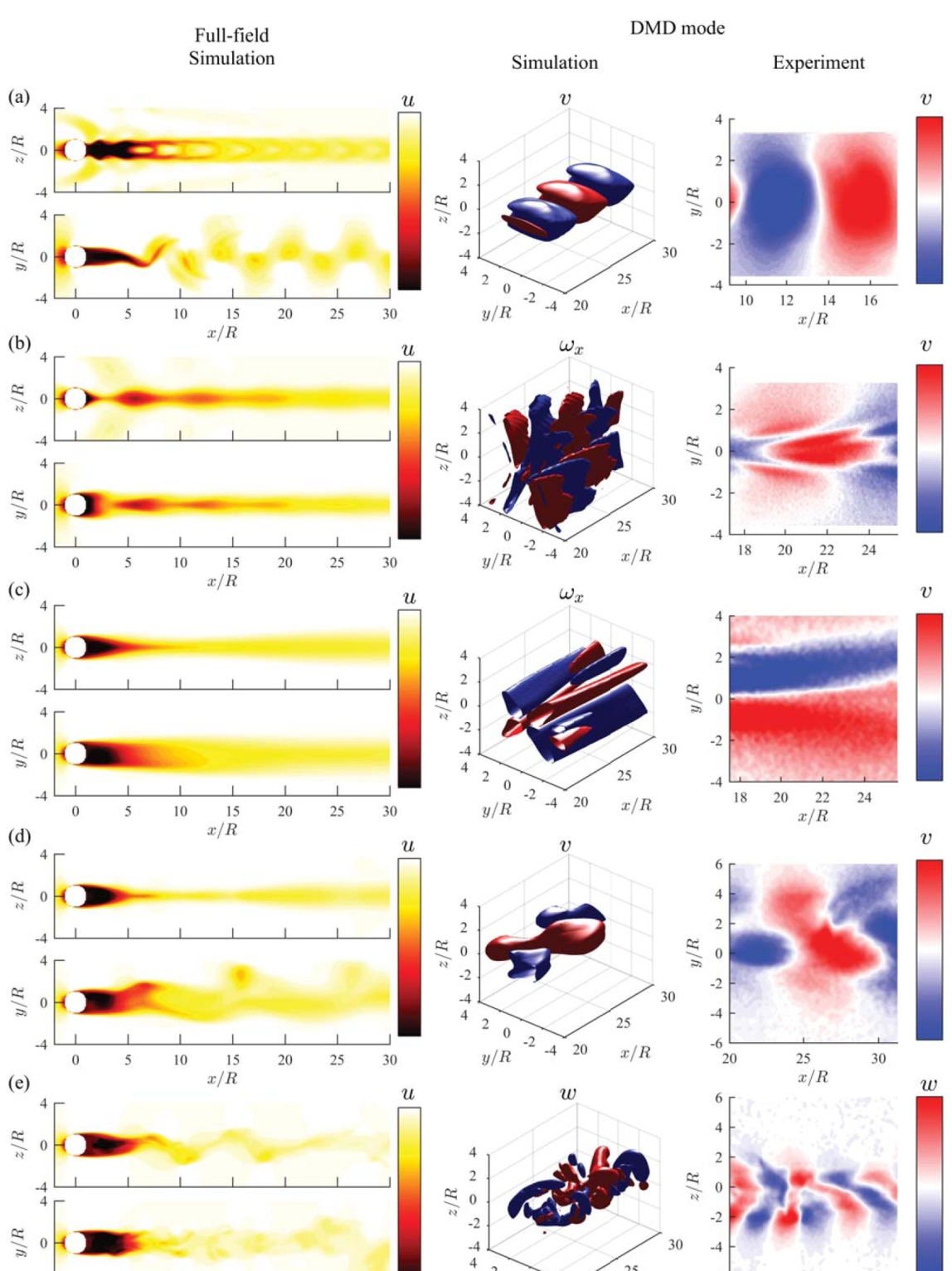
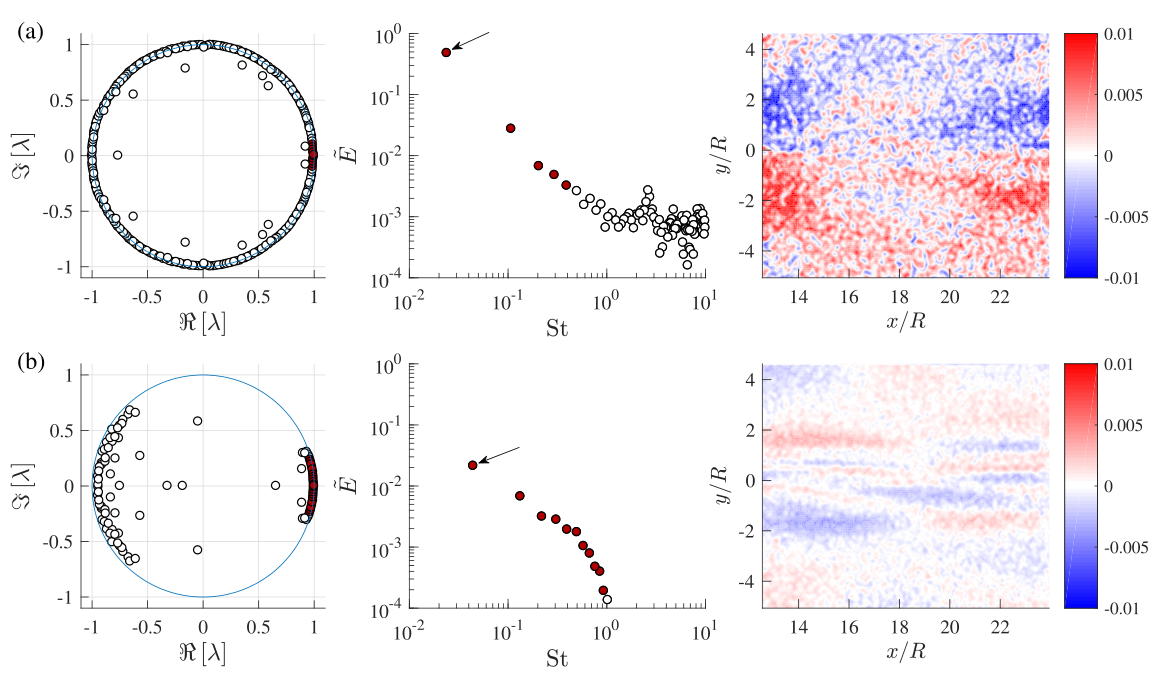
I develop data-driven methods that extract physically meaningful flow structures from limited experimental data. My primary tool is dynamic mode decomposition (DMD), a technique that decomposes unsteady flow fields into spatiotemporal modes. Applied to stratified wake experiments, DMD reveals the dominant oscillatory structures that characterize different wake regimes.
My 2022 paper on this topic was selected as an Editor's Suggestion in Physical Review Fluids.
Related: Ohh & Spedding (2022) PRF, Chinta, Ohh et al. (2022) PRF
Air-Sea Interaction
Describe your current postdoctoral research with Luc Lenain in the Air-Sea Interaction Laboratory. Topics may include: surface wave dynamics, air-sea fluxes, upper ocean turbulence, wave breaking, remote sensing, or instrumentation. Add figures when available.
Publications
-
The effects of stratification on the near wake of 6:1 prolate spheroid
Journal of Fluid Mechanics , 997 , A43 (2024)
-
Wake identification of stratified flows using dynamic mode decomposition
Physical Review Fluids , 7 , 024801 (2022)
-
Physical Review Fluids , 7 , 033803 (2022)
-
Leveraging fluid-structure interaction for passive control of flapping locomotion
APS Division of Fluid Dynamics Meeting (DFD16) (2016)